AIChilles: Automatically Uncovering Hidden Weaknesses in AI-Evolved Systems
This post is part of the AI-Driven Research for Systems (ADRS) blog series, where we explore how AI can be applied to systems research. We feature exciting work on AIChilles this week — an automated framework for uncovering hidden weaknesses in AI-evolved systems.
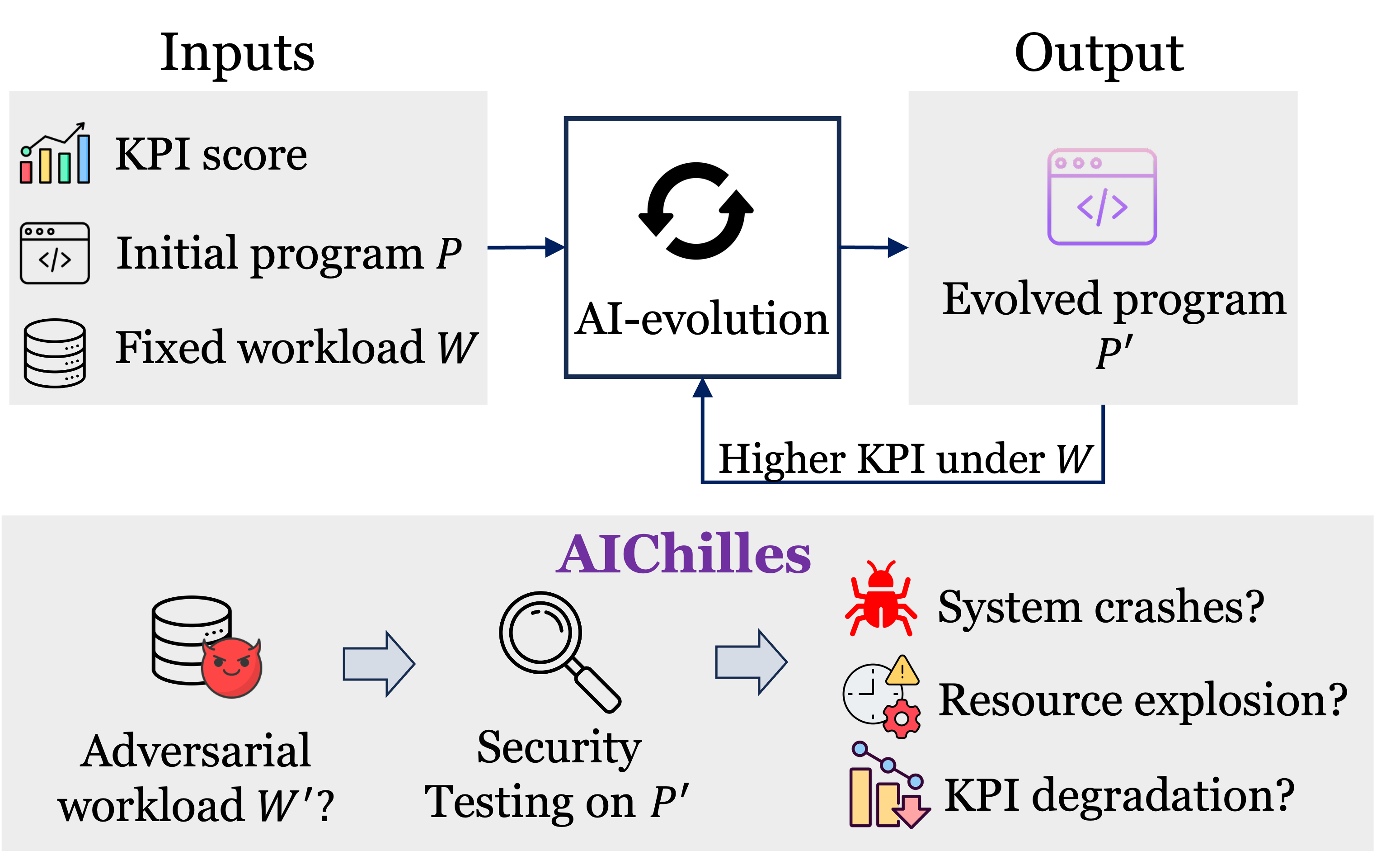
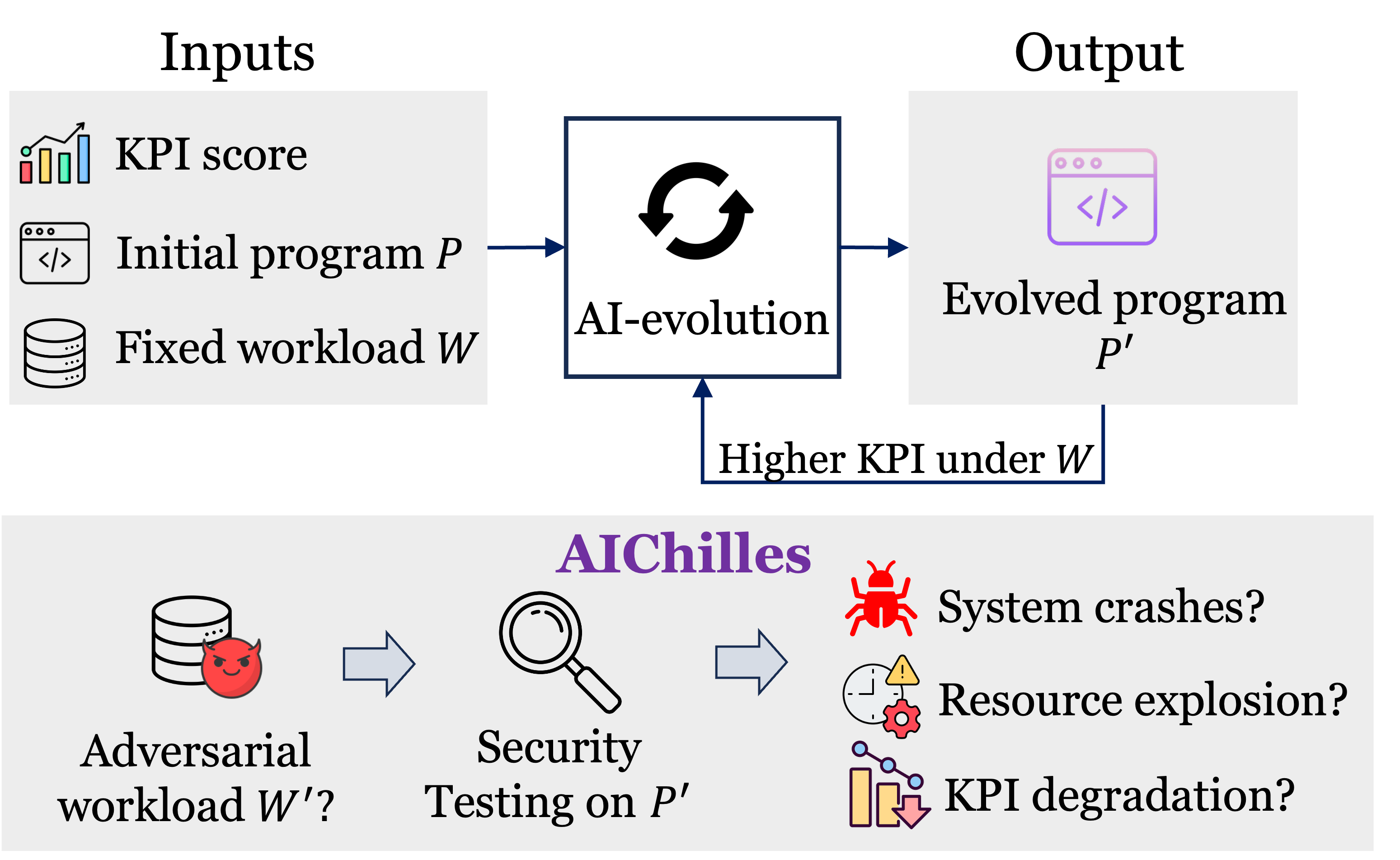
AI-evolving frameworks like AdaEvolve, OpenEvolve, and Engram rewrite core systems algorithms and report big performance score gains over human-designed heuristics. But these evolved programs are evaluated on a fixed set of workloads, and the scoring function may be incomplete. System operators would ask: Should I really deploy the evolved program? What's the risk here?
In a motivating case study, we found that AI-evolved programs can score worse and run much slower on unseen but valid workloads. Therefore, given the speed and scale of AI-evolution, we need automated ways to find these weaknesses before the code reaches production.
We introduce AIChilles, an automatic framework that uncovers the "Achilles' heel" of AI-evolved systems. It treats the human-written program P as a differential oracle for the evolved program P′, and searches for valid workloads where P′ regresses in correctness, runtime, memory, or output quality.
Key findings:
- 🔎 Across 5 systems × 3 frameworks × 2 LLMs (30 evolved programs), AIChilles finds 49 distinct hidden weaknesses
- 🧭 Weaknesses in AI-evolved programs depend on both the application and the evolution framework.
- 🛡️ Putting AIChilles inside the evolution loop removes the weaknesses, but the score gains shrink (e.g., Prism 19%→0%, TXN 49%→3.9%).
AIChilles serves as a cautionary tale for AI-evolved systems: (1) Be careful with AI overfitting to the test workloads. (2) Operators must make implicit system constraints explicit in the objective, or AI may sacrifice them silently.
- 📝 Paper: arxiv.org/abs/2606.15834
- 👩💻 Code: github.com/lesleychou/aichilles
- 🏠 Project Page: lesleychou.github.io/aichilles
- ✍️ Previous Blogs: https://ucbskyadrs.github.io/
- 💬 Join us: join.slack.com/t/adrs-global and Discord
- Follow us: x.com/ai4research_ucb
The Problem: High Scores Are Not Equal to High Robustness
A wave of AI-evolving frameworks now casts systems-algorithm design as an agentic code-improvement loop: an AI agent proposes a candidate program, an evaluator scores it on a fixed set of workloads, and the highest-scoring candidates are fed back into the next round. This has been applied to ADRS applications such as transaction scheduling, MoE load balancing, multi-cloud transfer, prefix-cache optimization, and GPU model placement, often beating hand-written heuristics.
There is a catch. When a human writes these heuristics, the KPI score is only part of what they care about. They also weigh robustness, scalability, and predictable resource use, but these goals stay implicit: they may live in the engineer's judgment, not in the evaluator.
This produces two possible risk modes:
- Overfitting to the test workloads. The evolved program tunes itself to the evaluator's fixed inputs and regresses on other valid workloads it was never scored on.
- Incomplete objective. Because robustness and scalability are not scored, the AI can lift the KPI by sacrificing them: it swaps a compact heuristic for much more complex logic (sometimes an order of magnitude longer) that hides crashes, DoS-style resource blowups, and silent quality regressions.
Because these programs sit on the critical path of production systems, these risks may lead to a big effect. A placement controller that stalls, a scheduler that exhausts memory, or an expert-assignment routine that crashes can take down the very system the optimization was meant to improve. Before deploying an AI-evolved program, an operator has to ask what valid workload could make it fail, and whether that risk is acceptable.
💡 The research question we ask: given a human baseline P and an AI-evolved P′, is there a valid workload on which P′ is actually worse than P?
A Motivating Case: Prism Model Placement
We first stumbled on this risk by hand, inspecting AI-evolved versions of Prism, a KV-cache-aware model-placement policy for multi-LLM serving. The human design is a single greedy pass (~45 lines): for each model, place it on the GPU with the lowest current KV-cache pressure.
The evolved versions look impressive but hide regressions:
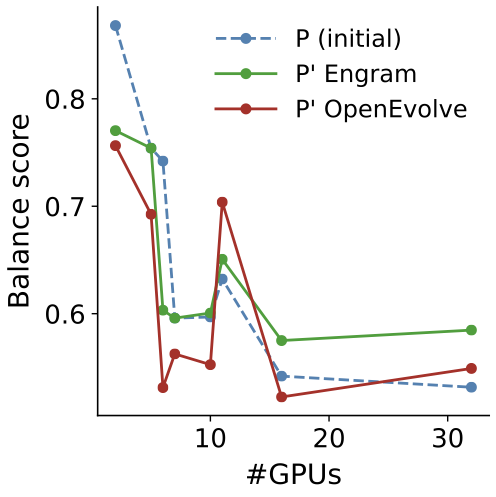
- OpenEvolve (~66 lines) keeps a greedy shape but, for every candidate GPU, scans all other GPUs to compute a balance penalty. Its penalty also "reward-hacks" patterns specific to the benchmark, mis-ranking GPUs on workloads with many small high-pressure models.
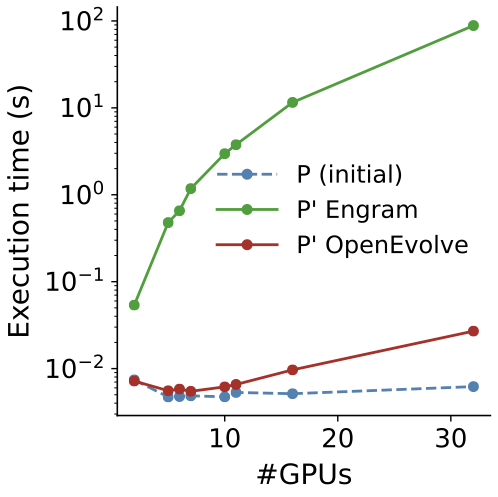
- Engram (~456 lines) replaces the single pass with repeated heuristic search: many model orders, placement rules, and an aggressive local search over swaps/moves, each trial recomputing GPU pressure. Great on the benchmark; far slower as GPUs and feasible moves grow, and prone to getting trapped in locally-attractive placements.
Both improve the benchmark score while introducing a runtime regression (a placement controller that now takes seconds can leave a cluster on a stale placement) and an optimality regression on shifted workloads. Figure 2 shows the details.
What Counts as a Weakness
AIChilles runs both programs on the same valid workload w. Each execution returns a metric tuple ⟨q, t, m⟩ (quality, time, peak memory) or an abnormal outcome ⊥. A hidden weakness/risk is a divergence violation: a valid input on which P′ is worse than P under a security- or system-relevant metric.
| Weakness type | Condition (exists w) | Intuition |
|---|---|---|
| Correctness | P′(w) → ⊥ ∧ P(w) ↛ ⊥ | P′ crashes / returns invalid output where P succeeds |
| Scalability–Time | t′ > Fₜ · t | P′ is Fₜ× slower on the same input |
| Scalability–Memory | m′ > Fₘ · m | P′ uses Fₘ× more peak memory |
| Optimality | q′ < q | P′ runs fine but returns a worse solution |
How AIChilles Works
Naively pointing an LLM at "finding weaknesses" fails for three reasons: (1) the workload space has hidden, application-specific validity constraints that an agent may miss; (2) a single agent often fixates on the first crash it finds and fails to find more distinct weakness types; and (3) it wastes budget re-triggering the same faulty code path. To this end, AIChilles is a three-stage pipeline built to improve the efficiency of weakness search.
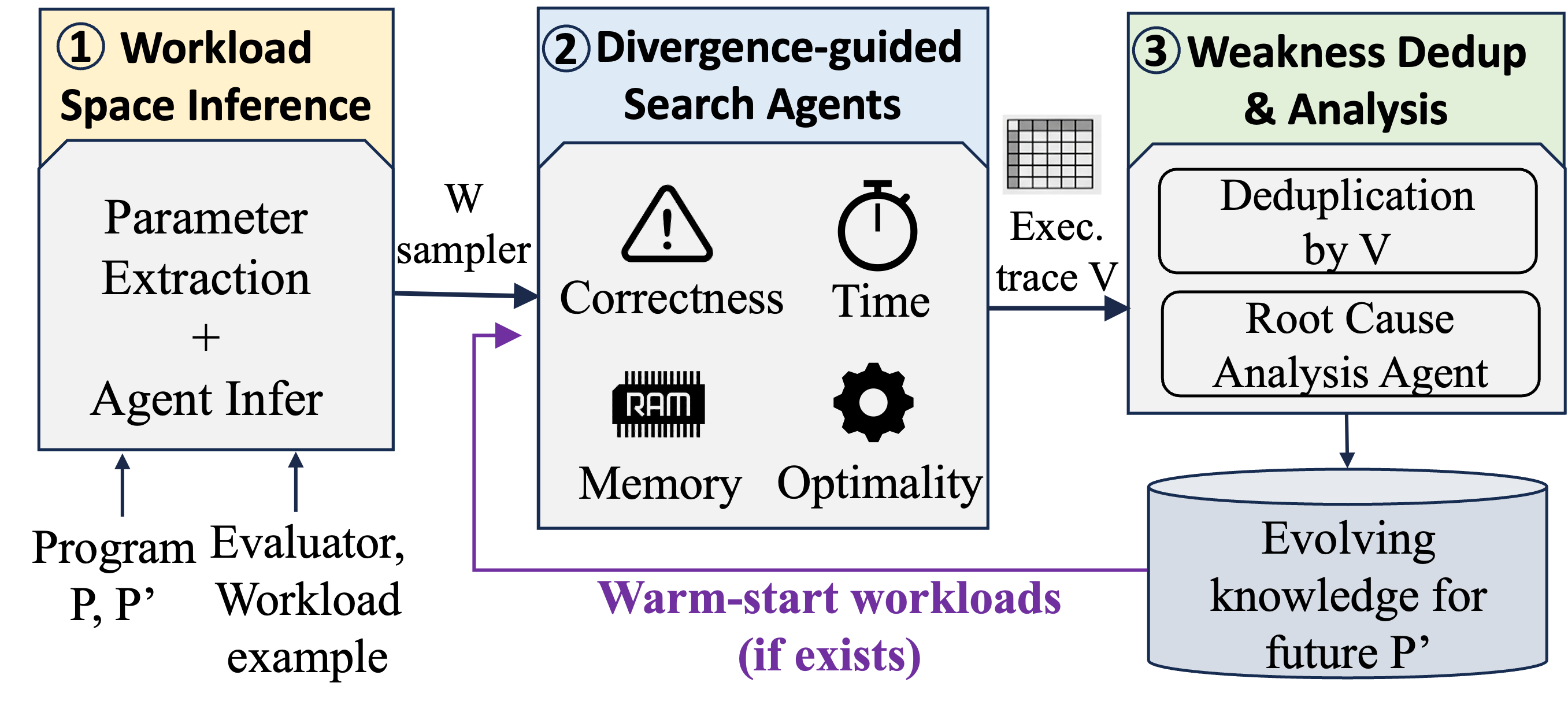
Stage 1 · Semantic-Aware Workload-Space Inference
Workload knobs are buried inside evaluators, helper functions, and constants, and some validity rules are only implied by program logic (e.g., in Prism a model must fit on one GPU, so model_size_max is bounded by GPU memory). Prompting an agent to extract parameters directly is unstable: different runs recover different parameter sets.
AIChilles therefore separates deterministic extraction from semantic reasoning. A Python-AST (Abstract Syntax Tree) pass extracts concrete candidate parameters (module constants, default arguments, literal call values); the agent then infers valid ranges and cross-parameter constraints into a workload grammar. The result is a workload sampler, validated by running it on P (typically one revision suffices).
🔧 On Prism, prompt-only agents recover anywhere from 2 to 5 "parameters" across different trials. We propose a deterministic pass that first anchors the agent to a stable, real parameter set, eliminating false positives from invalid workloads.
Stage 2 · Divergence-Guided Search, One Agent per Weakness Type
We found that a single monolithic agent collapses onto the first failure mode it finds. AIChilles instead assigns a separate sub-agent per weakness type (correctness, time, memory, optimality). Each mutates workloads to maximize evidence for its target, then both programs are executed and checked against that type's divergence condition. The search is divergence-guided: it prioritizes workloads where P′ is measurably worse than P.
AIChilles uses execution trajectory as a proxy for behavioral diversity. For each workload, it records how often each line of P′ executes and represents it as a vector. A candidate is prioritized when its trajectory differs from those already explored. This steers the search toward new program behavior rather than surface-level input changes, and it also helps group repeated witnesses during root-cause analysis.
🔧 We compare three diversity signals: workload distance, path coverage, and execution frequency. Execution frequency exposes the most distinct weaknesses because it is finer-grained than path coverage and more root-cause aligned than raw workload distance.
Stage 3 · Deduplication, Root Cause, and a Warm-Start Knowledge Base
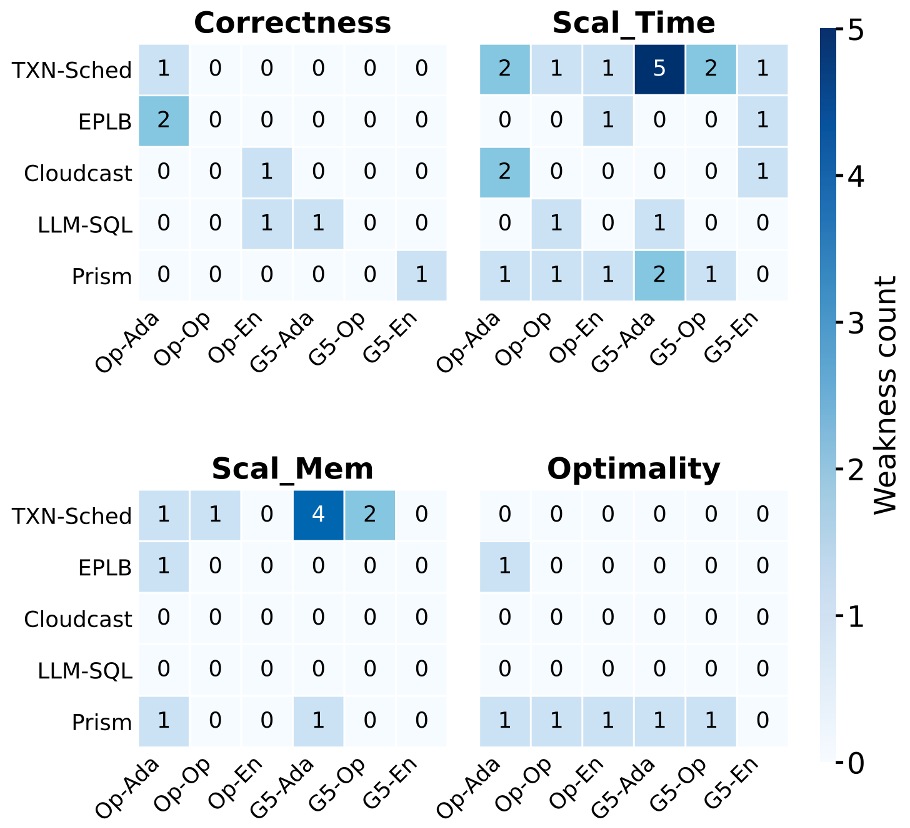
Several adversarial workloads may share the same root cause. AIChilles deduplicates by mapping each workload's dominant lines back to a trigger function, then groups workloads by trigger function and keeps the highest-divergence representative. A distinct weakness is one such group. An agent then writes a root-cause explanation for each weakness group by analyzing the program behavior.
Finally, AIChilles keeps an evolving knowledge base per application: confirmed adversarial workloads, near-miss high-divergence workloads, and weakness-type statistics. When testing the next P′ for the same application, it replays these as warm-start seeds (re-validated against the new program), discovering distinct weaknesses faster.
Results: 49 Hidden Weaknesses
We evaluated AIChilles on 5 systems applications from ADRS: transaction scheduling (TXN-Sched), EPLB, Cloudcast, LLM-SQL, Prism, 3 evolution frameworks (AdaEvolve, OpenEvolve, Engram), and 2 frontier LLMs (GPT-5, Claude Opus-4.6): 30 evolved programs in total, always testing the highest-scoring program each framework produced.
Across this spectrum, AIChilles finds 49 distinct weaknesses: the most common are runtime regressions (25 instances), then memory (11), correctness (7), and optimality (6).
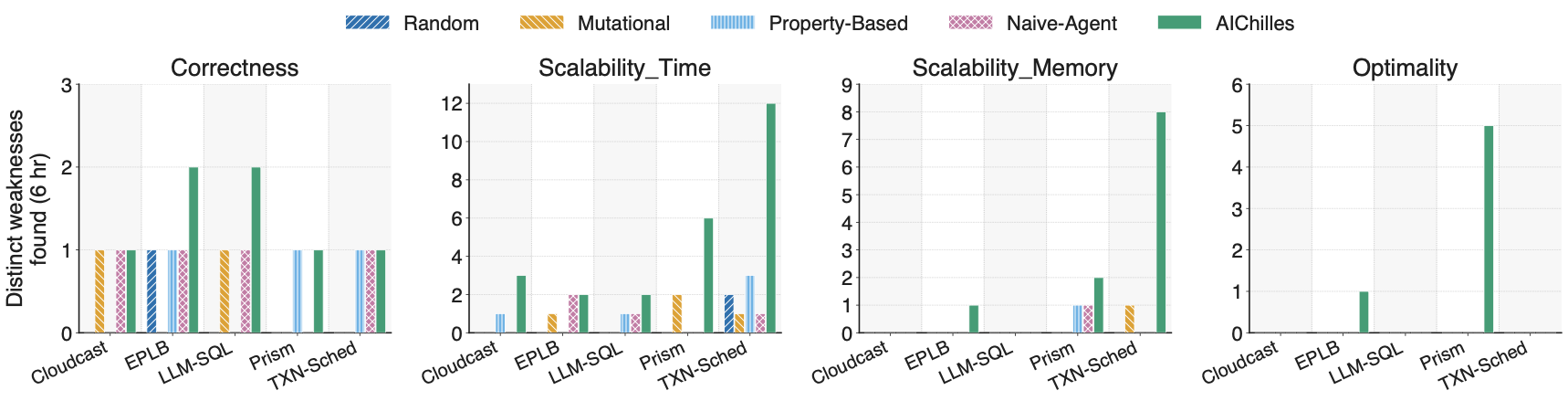
Against four weakness-finding baselines under an identical 6-hour budget (all using AIChilles' recovered parameters), AIChilles finds more distinct weaknesses across every type. AIChilles is also cheap: on Prism it converges in 20–30 minutes and uses fewer tokens than a naive agent.
Case Studies: What the Weaknesses Look Like
EPLB: a correctness crash from batching. The human program assigns expert replicas one at a time, recomputing load each step. Opus/AdaEvolve batches assignments with a fixed topk list and implicitly assumes the batch size never exceeds the number of experts returned. With 8 logical experts but 288 physical replicas, a batch of 20 indexes past an 8-element tensor and crashes, on a perfectly valid workload. The same batching also causes an optimality regression: a fixed top-k list can't track the load distribution as it shifts, producing worse balance as experts and layers grow.
TXN-Sched: a scheduler that becomes the bottleneck. The baseline keeps one active prefix with bounded sampling. GPT/AdaEvolve turns this into A*/beam search with large-neighborhood refinement, caches every explored prefix, and restarts its trial budget after each improvement. Time and memory grow with the number of explored prefixes: an optimization meant to reduce lock conflicts instead burns CPU and memory before transactions even run.
A recurring pattern: evolved programs improve the score by storing more intermediate state (search prefixes, device-transfer copies, dense cost matrices) that fits small evaluator workloads but explodes on larger valid inputs.
| Application | Original P | Opus/AdaEvolve P′ |
|---|---|---|
| TXN (N transactions) | O(N) | O(N²) |
| EPLB (L layers, E experts, R replicas, B max replicas) | O(LEB) | O(LEB + LR) |
| Prism (M models, G GPUs) | O(M+G) | O(MG) |
🔎 Dig into more details on the results explorer: browse every weakness with side-by-side P vs P′ source, the triggering workload, and P-vs-P′ regression curves.
Can We Fix It? AIChilles in the Loop
If AIChilles can find these weaknesses, can it prevent them? We tried two mitigations with AdaEvolve + Opus-4.6.
Prompt patching (warning the model about the four weakness types) is not enough: the evolved programs still contain weaknesses across applications.
AIChilles-in-the-loop works: after each candidate is generated, we run AIChilles for 100 iterations; any adversarial workload triggers a large penalty and is returned as feedback. A candidate must now both improve the score and pass the weakness checks: AIChilles effectively becomes CI/CD for ADRS. The final selected programs no longer expose AIChilles-found weaknesses.
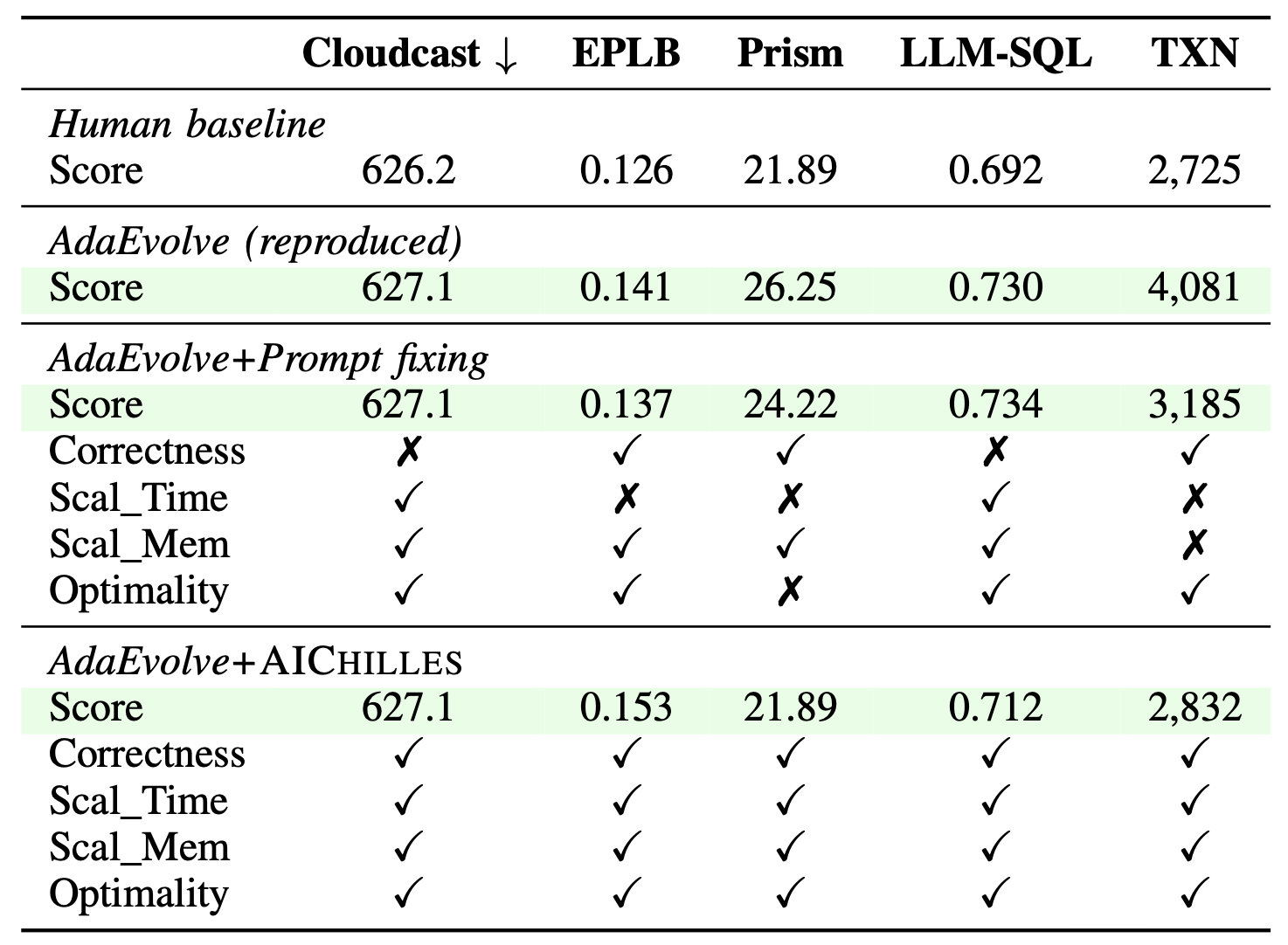
⚖️ Robustness has a price. Once the weaknesses found by AIChilles are fed back to the evolution loop, the gains of AI shrink: Prism falls from a 19% improvement to 0% (back to the human baseline) and TXN-Sched from 49% to 3.9%. This implies that part of the reported "improvement" may have come from sacrificed robustness on the evaluator's blind spots.
Conclusion
AI-driven system evolution has great potential, but its gains may come with hidden weaknesses that fixed benchmarks did not reveal during evaluation. AIChilles is a cautionary tale for optimizing systems with AI: an evolution loop optimizes only what its objective measures, so any goal left implicit (robustness, scalability, predictable resource use) is a goal the AI can trade away for score.
AIChilles argues that evaluating AI-evolved systems requires testing worst-case behavior across valid workload spaces, not just average-case scores. It automatically surfaces distinct hidden weaknesses across evolved programs and can be added back into the evolution loop to prevent them.
Given the speed and scale of AI-generated code development, we believe automated weakness discovery is a necessary step toward safely deploying AI-generated systems code.
Try It!
AIChilles is open-source. If you build or audit AI-evolved systems, we'd love you to try AIChilles to stress-test them. More exciting findings are coming on the project page.
📬 Please feel free to contact Lesley (Yajie) Zhou or open an issue on GitHub if you have any questions or suggestions. We look forward to pushing AI-driven system optimization to the next level with the community. :)
Citation
If you find AIChilles helpful, please cite:
@article{zhou2026aichilles,
  title={AIChilles: Automatically Uncovering Hidden Weaknesses in AI-Evolved Systems},
  author={Zhou, Yajie and Li, Ao and Silla, Ashwin and Liu, Zaoxing and Sekar, Vyas},
  year={2026},
  journal={arXiv preprint arXiv:2606.15834}
}
Contribute to the ADRS Blog Series!
The AI-Driven Research Systems (ADRS) initiative is an open, collaborative effort to explore how AI can accelerate scientific discovery itself, from evolving algorithms to optimizing real-world systems.
If you've built, optimized, or experimented with AI-driven research tools, we'd love to hear from you. Share your experiences, insights, or case studies with us in the ADRS Blog Series.
👉 Reach out to the UCB team via email: ucbskyadrs@gmail.com
💬 Join UCB on join.slack.com/t/adrs-global and Discord